
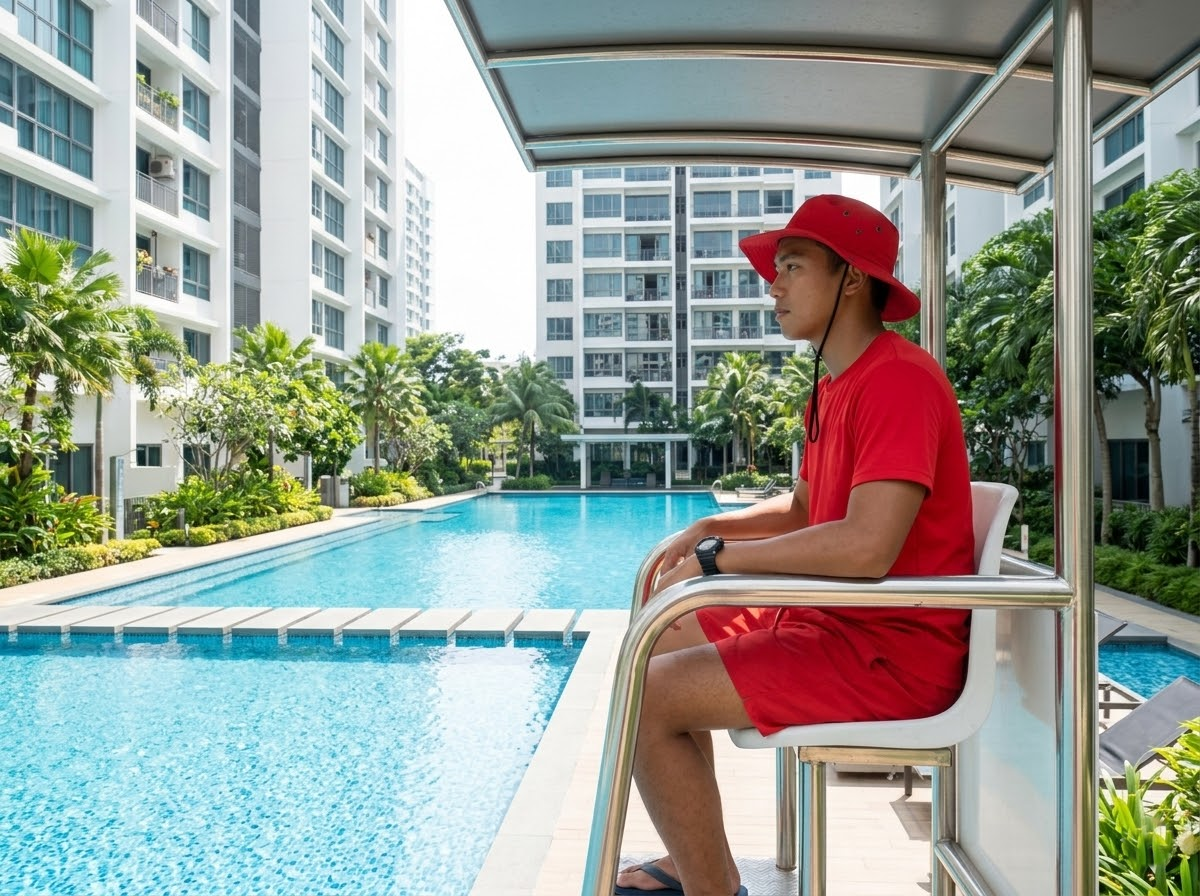
You cannot just sign up for a final exam and become a professional rescuer tomorrow. Training academies require you to pass a few basic physical tests first. These tests prove you have the foundational fitness to handle heavy rescue training.
Here are the basic requirements you usually need to meet:
These requirements exist because lifeguards must be physically capable of performing rescues in real situations. Swimming endurance, water confidence, and quick reaction are important for keeping swimmers safe.
Many candidates spend time improving their swimming technique and stamina before taking the Bronze Medallion examination.
When asking how to get lifeguard qualification, you need to look at the structured pathway set by the Singapore Life Saving Society (SLSS). You do not learn everything in one single class. The training is broken down into clear stages.
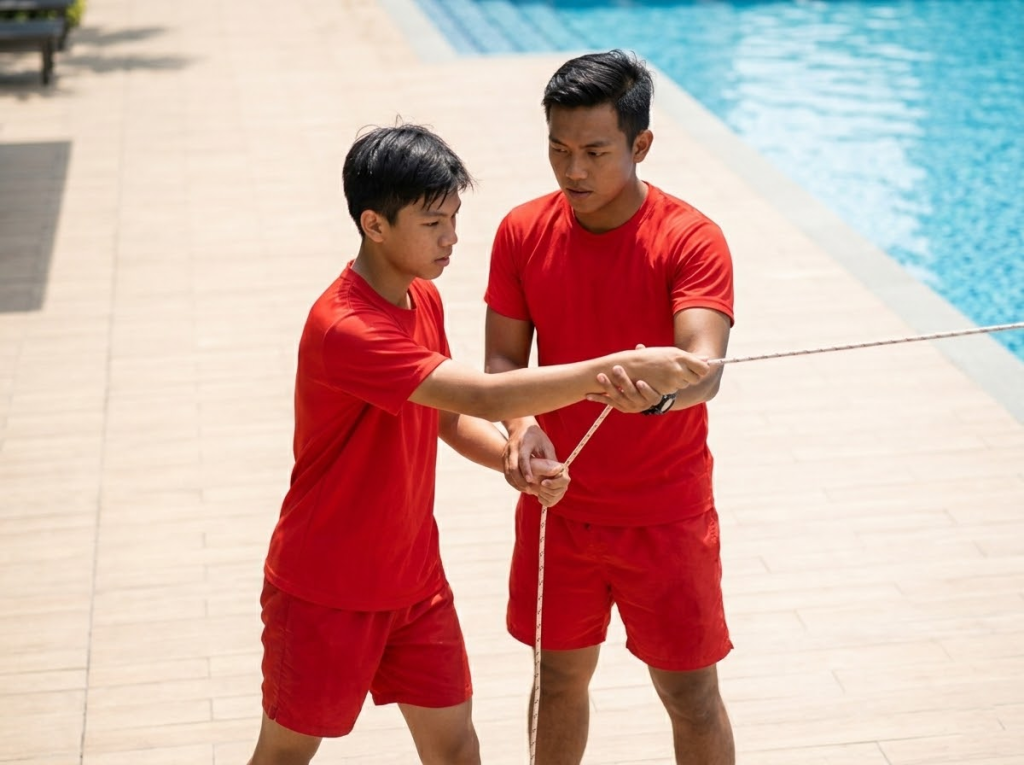
These three foundational courses form the basis of your water safety knowledge. You must complete them before moving on to advanced rescue training.
A professional rescuer needs medical skills. Drowning victims often require immediate chest compressions. To become fully qualified, you must complete a Standard First Aid and CPR course accredited by the Singapore Resuscitation and First Aid Council (SRFAC). You will learn how to perform CPR on adults, children, and infants using medical training dummies.
You will also learn how to use an Automated External Defibrillator. This device delivers an electric shock to restart a heart during cardiac arrest.
Along with CPR, you will study standard first aid. This teaches you how to bandage severe cuts, treat chemical burns, manage bee stings, and stabilize suspected spinal injuries using a rigid backboard.
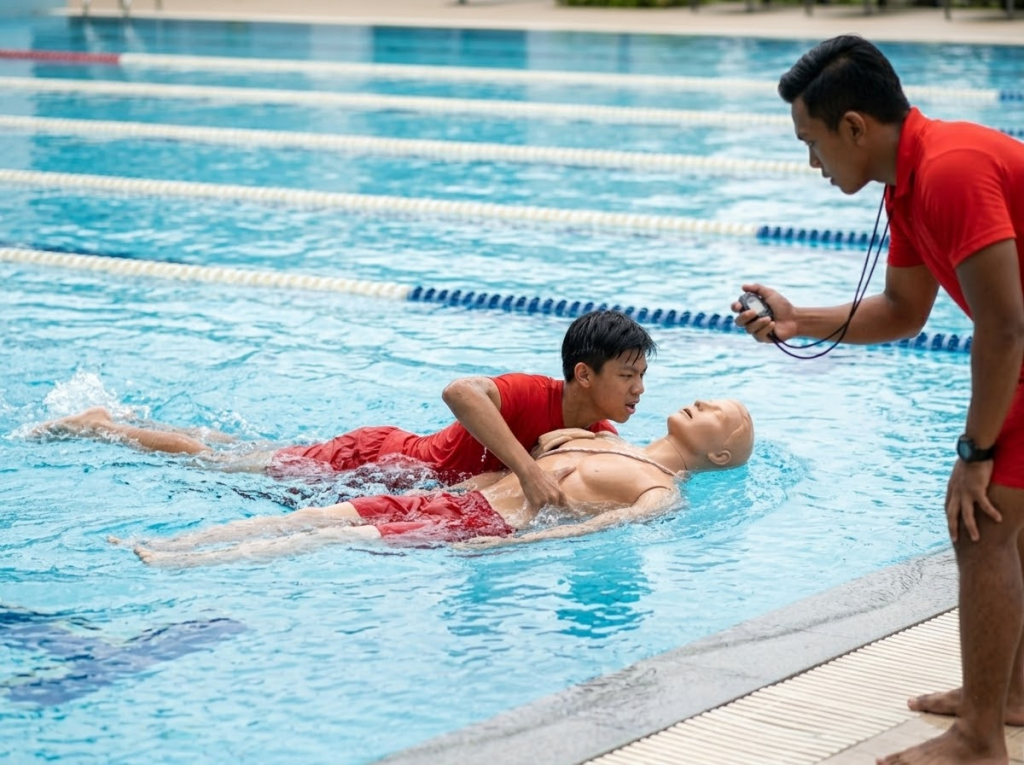
Alt text: Instructor timing a trainee during a physical water rescue test.
The Bronze Medallion is your main goal. This certificate is widely recognized as the standard working qualification for aquatic professionals in Singapore. It focuses on heavy physical rescues and timed tests.
During the Bronze Medallion course, you will learn:
To pass this stage, you must complete a timed rescue test. A common test involves swimming to a submerged casualty and bringing them back to the edge within a strict time limit of one minute and fifteen seconds.
Passing this physical exam proves you have the speed and endurance to save a life.
After completing lifesaving training and Bronze Medallion certification, candidates can begin applying for lifeguard roles.
Many swimming pools, sports clubs, and recreational facilities hire lifeguards who hold these qualifications. Some employers may also require additional certifications such as first aid or pool lifeguard awards.
At this stage, you often gain practical experience supervising swimmers and managing pool safety. Working as a lifeguard also helps build confidence in rescue techniques and real life emergency response.
Many people wonder how long the training process takes.
In most cases, a dedicated trainee can complete the full pathway in two to four months depending on course schedules and training frequency.
Some programmes run weekly sessions while others provide intensive training that finishes faster. Progress also depends on the candidate’s swimming ability and physical fitness.
Strong swimmers may move through the course more quickly because they are already comfortable performing endurance swims and rescue drills.
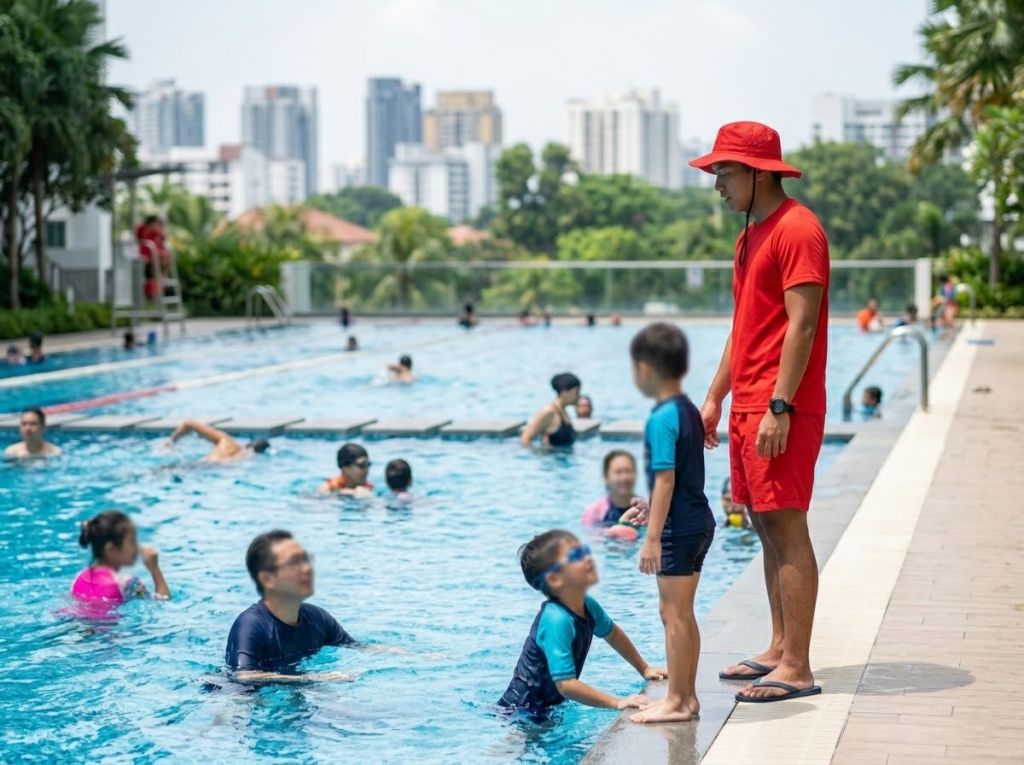
Alt text: Fully qualified lifeguard supervising an active swimming pool.
Once you hold the Bronze Medallion and a valid CPR certificate, you are ready to look for work.
Singapore has a huge demand for aquatic safety professionals. You can apply for jobs at ActiveSG public swimming complexes, private residential condominiums, tourist hotels, and luxury country clubs.
Working at a public pool provides great experience with large crowds and noisy environments. Working at a private condo pool offers a quieter environment where you can build friendly relationships with regular residents. Water parks offer a fast-paced environment where you monitor massive wave pools and tall water slides.
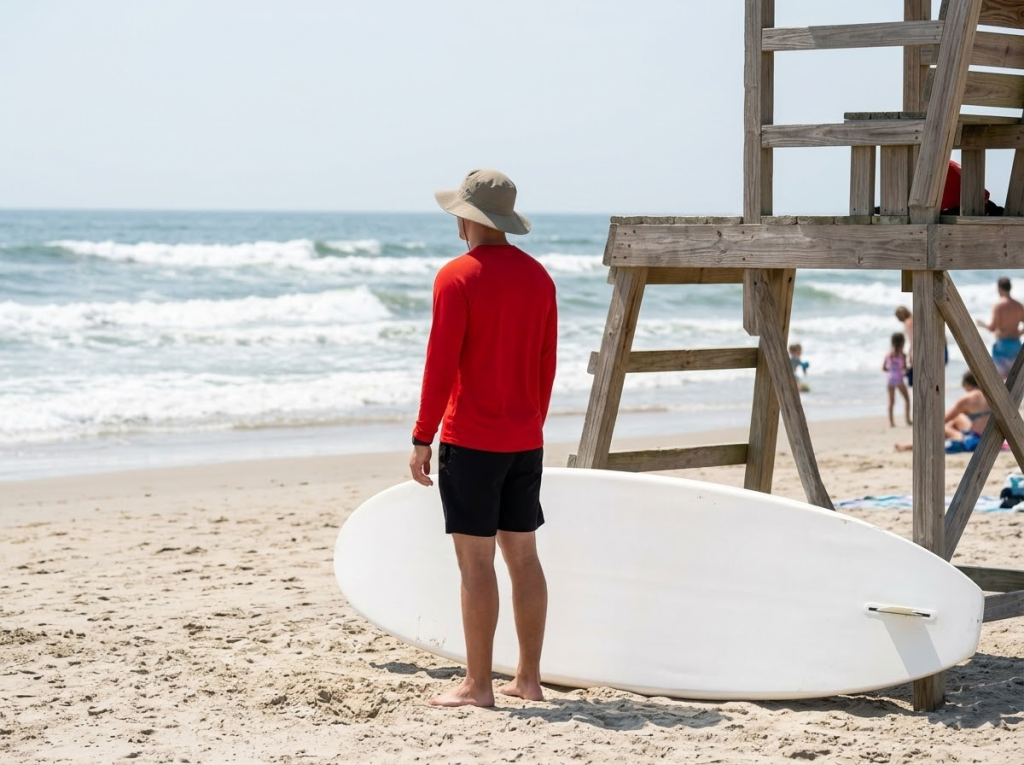
Your learning does not stop at the Bronze Medallion. If you want to work at the beach, you can pursue higher qualifications. The Bronze Cross and Award of Merit courses teach open water rescue skills. You will learn how to handle strong ocean currents, massive waves, and changing tides. You will also learn how to use a rescue board to paddle out to victims in the deep ocean.
Holding a rescue certificate opens many doors in the sports and recreation industry. Many people use their lifesaving background to become certified swimming instructors. Teaching children how to swim is a highly rewarding career.
Your deep understanding of water safety will make you a much better teacher. If you decide to teach, you can look into certifications from the National Registry of Coaches or AUSTSWIM. Others move into aquatic event management, where they plan safety protocols for triathlons and corporate team building days.
You must remember that safety certificates do not last forever. Medical protocols change constantly, and your physical skills can fade if you do not practice them. In Singapore, your CPR and First Aid certificates usually expire after two years.
To keep working legally, you must attend a refresher course before your certificates expire. For example, the guidelines for chest compressions might update based on new medical research. A refresher course ensures you are always using the safest and most effective techniques. It also gives you a chance to practice your water rescues again under the supervision of an instructor. Staying current with your renewals proves you are a dedicated professional who takes public safety seriously.
Figuring out how to get lifeguard qualification is the first step toward a highly rewarding career. If you are ready to start your journey, Swimwerks is here to help. We provide a structured training pathway to guide you through the lifesaving courses all the way to your final certifications.
If you are interested in learning how to get lifeguard qualification in Singapore, Swimwerks offers lifesaving courses designed for aspiring lifeguards.
Swimwerks provides training programmes that include:
These courses teach practical rescue skills, water safety awareness, and emergency response techniques needed for lifeguard work.
Beyond training, we are a major provider of aquatic services across Singapore. We offer our top graduates direct job interviews for positions within our company.
Our aquatic services include:
Ready to turn your swimming skills into a professional qualification?